The money that has already left is no longer the urgent part. The urgent part is the next withdrawal. Whoever made this one may still have a way in, so the first move is to stop the account. Then you record this transaction in a form that can be used. Only after that do you work out how it happened.
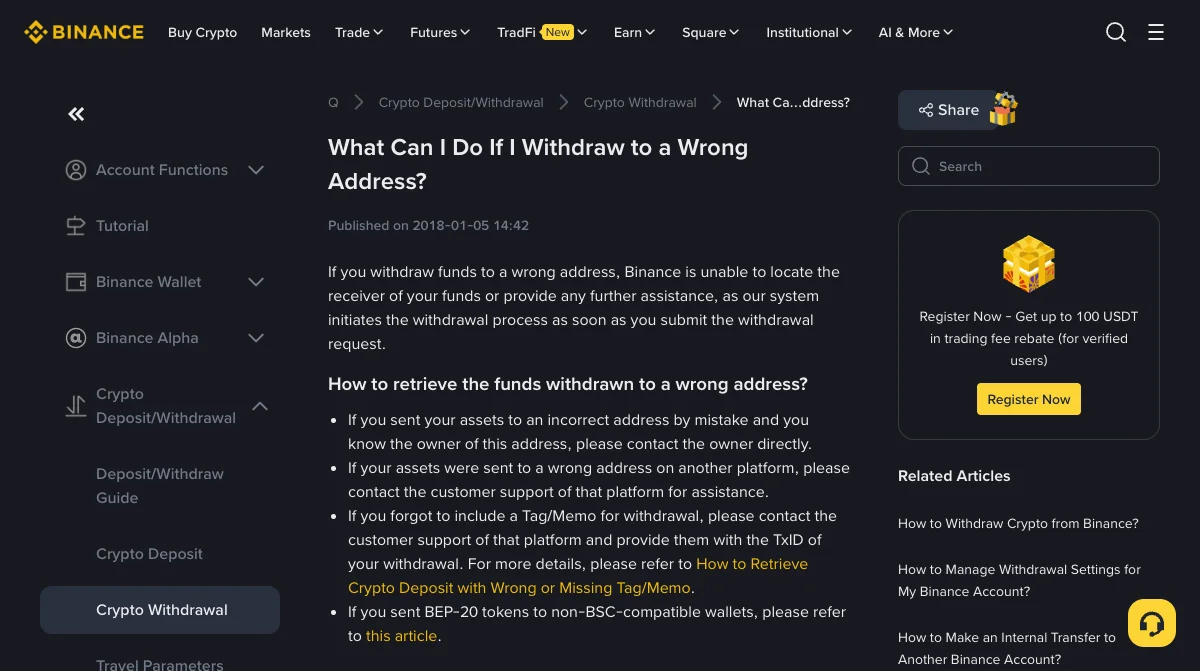
Be clear about what is possible. Binance’s own page on mistaken withdrawals says its system starts the withdrawal as soon as the request is submitted. A transfer confirmed on a blockchain cannot be pulled back by the exchange, the network or anyone who messages you offering to try. What sometimes works is a freeze at the place the funds landed, and that depends on speed and evidence.
The first ten minutes
- Disable the account: profile icon, Account, Security, Account Management, Disable Account. Or in the app: Account Info, Security, Manage Account, Disable Account.
- Screenshot the withdrawal in your history: amount, coin, network, destination address, time, and the transaction ID (TxID).
- Copy the TxID into a note with the time you first saw it.
- Do not post the TxID or the amount anywhere public.
Is it really theft? Two things to rule out first
Before treating it as theft, spend one minute ruling out the two things that look like it:
- Is it still pending? A withdrawal that has not completed is a reason to disable the account this second, not after reading further.
- Did it go to an address on your own whitelist (the saved list of addresses your account may send to)? Binance’s one-step withdrawal lets small amounts go to whitelisted addresses without 2FA. If the address is one of yours and the amount is small, find out who in your household or which bot you set up made it before you file anything.
If it went to an address you do not recognise, treat it as unauthorised and carry on.
How did they get in? Check the three usual routes
Each of them leaves a trace in a different place. Look at all three, because closing one while another is still open is how this happens twice.
The login was taken. The login history shows a session, device or location you do not recognise around the time of the withdrawal. Usually the password and a code were both captured by a fake login page or message, or a code was read out over the phone; the guide to giving a scammer your code covers that case. Fix: new password, new second factor, every unknown device removed.
An API key was used. Nothing in the login history, but the API management page shows a key with withdrawal permission. An API key, the access you give a trading bot or app, needs no login. Fix: delete every key you are not sure of, and read the API key guide before creating another.
An address was added to the whitelist earlier. The address is on your whitelist and you did not put it there. Fix: remove it, find out how the account was entered when it was added, and keep the whitelist limit on. That limit holds new addresses for 24, 48 or 72 hours, and the whitelist guide explains why it gives you time to notice.
Then check the email account behind the exchange account. If the intruder was in the inbox, the hacked email guide is your next step, because the email is how an exchange account gets reset.
How to report it to Binance and the police
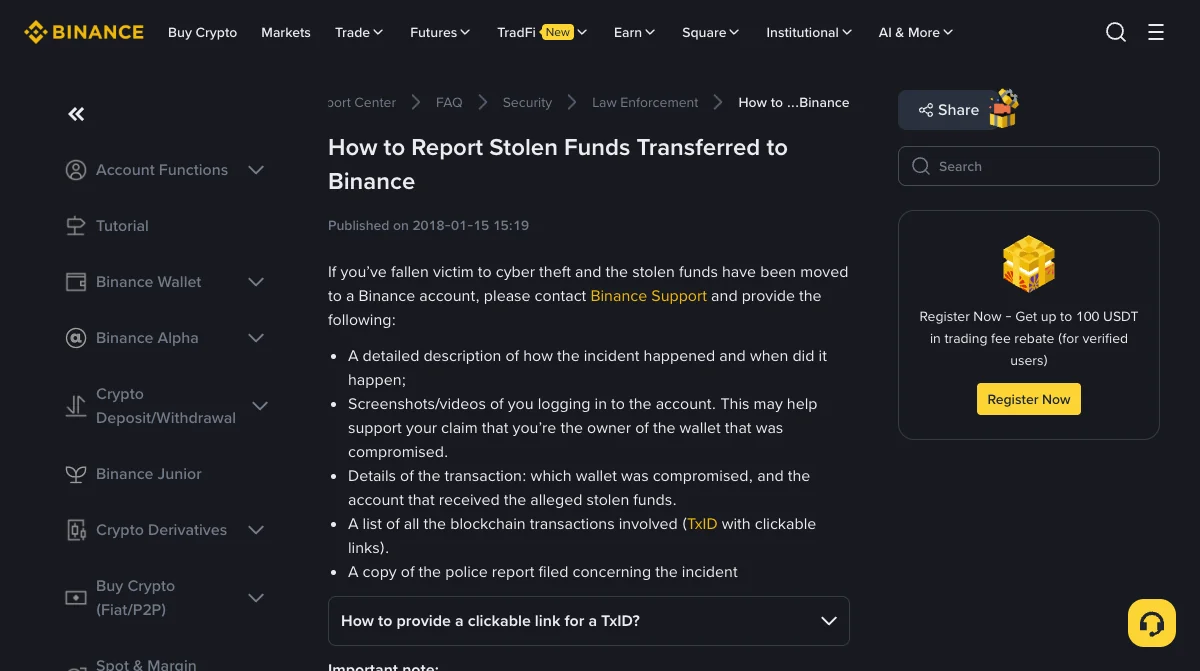
Open a case with Binance support from inside the app or your signed-in account; the first-hour guide lists what to put in it. If the funds went to another Binance account, Binance’s stolen-funds page says what it needs:
- a description of what happened and when;
- screenshots or video of you logging in to the account that was emptied, to show it is yours;
- which wallet was compromised and which account received the funds;
- every transaction involved, as a TxID with a clickable block-explorer link;
- a copy of the police report.
To make a TxID clickable, copy it from the withdrawal history, search for it on a block explorer (a public website that shows every transfer on that network), and copy the page address.
Then the police, or your country’s fraud reporting service. It is not a formality here. Binance says it cannot freeze a user’s assets on its own without an official freezing order from law enforcement or a court. It also says it works with law enforcement directly, and its support team will not share that information with you. So the police report is the path a freeze actually takes, and the quicker it exists the more there is to freeze. If the funds went to a different exchange, report to that exchange too, with the same TxIDs.
What to expect next, and what to ignore
Expect silence more than news. Investigations involving other platforms are slow, and the exchange will not report to you on what law enforcement asks it for.
Expect messages, too. A loss that was mentioned anywhere public, or a TxID that was posted, attracts offers to trace and recover the funds for a fee. None of them can do what they say. The guide to crypto recovery services explains how to tell, and the short version is that legitimate help never asks you for money first. If a firm you found yourself looks convincing, the recovery company check shows how old its website is and whether it is on California’s scam complaint list.
What you can still control is the account. When it is unlocked, there will be a hold of up to 48 hours on withdrawals. Rebuild it during that time: a second factor that a fake login page cannot capture, such as a passkey or security key, no API key you did not create today, and a whitelist with its limit switched on. If you set those up before you move anything back in, whoever did this has nothing left to come back to.
Binance pages read on 9 November 2026: What Can I Do If I Withdraw to a Wrong Address?, How to Report Stolen Funds Transferred to Binance, How to Manage Withdrawal Settings (last updated 3 March 2025) and How to Disable My Binance Account (updated 24 November 2025). That a transfer confirmed on the blockchain cannot be reversed is a property of how the networks settle, not a policy. Nothing here is legal advice, and no figure is given for how often funds are recovered, because we found none we could trace to a source.
What Binance can and cannot undo
Can Binance reverse a withdrawal I did not make?
Not once it has gone out. Binance says its system starts the withdrawal as soon as the request is submitted, and a transfer confirmed on a blockchain cannot be reversed by anyone. What can sometimes happen is a freeze at the platform where the funds arrive, which needs a fast report and, usually, an official order.
Will Binance freeze the account that received my crypto?
If the funds landed in another Binance account, Binance says it cannot freeze a user's assets on its own without an official freezing order from law enforcement or a court. That is why it asks for a police report as part of a stolen-funds report, and why the police report should be filed quickly.
How did they withdraw without my 2FA?
Three common ways: the login and second factor were both taken, for example through a fake login page or a code read out to a scammer; an API key with withdrawal permission was used, which needs no login at all; or a small withdrawal went to an address already on the whitelist using one-step withdrawal, which Binance says can skip 2FA for small amounts. The account's login history, API key list and whitelist tell you which.
Someone says they can trace and recover it for a fee. Should I pay?
No. Real reports to exchanges and the police cost nothing, and nobody can reverse a confirmed transfer. An offer that arrives after a loss, asking for money first, is the recovery scam described in the guide to crypto recovery services.