All of the places that can actually do something about stolen crypto take reports for free. Report first to the exchange the money left from and the platform it landed on, then to the police, and in the US to the FBI’s Internet Crime Complaint Center (IC3) and the Federal Trade Commission (FTC). None of them will charge you, and none of them will contact you first offering to speed things up.
Expect a freeze, not a refund. A confirmed transfer cannot be pulled back by anyone. What can happen is that the platform now holding the funds freezes them, and Binance says it cannot do that without an official order from law enforcement or a court. That is why the police report matters more than it feels like it should.
The order, and why
- The exchange you sent from, within the hour. It can lock your account and record the transaction while the trail is fresh.
- The platform the funds landed on, if you can tell from the address. It is the only place that can freeze them.
- The police, the same day. Their report is what a platform needs before it can freeze anything.
- IC3 and the FTC (US), or your country’s fraud-reporting service. These reports go into the cases investigators build.
1. The exchange the money left from
What it can do: lock your account so nothing else leaves, record the case, and pass the details on to law enforcement when asked. What it cannot do: reverse a withdrawal that has been confirmed on the blockchain.
On Binance there are three ways in, all on its own help page. Open the transaction in your history and press Report Scam, which takes you to the Case Report Form; have the transaction ID (TxID) and the other details from the evidence pack ready to paste. Or, logged in, open the Binance Support icon, then View All under Self Service, then Non-P2P Related Scam Report. Or tell the support chat “I want to file a scam report” and use the form link it sends back. The form wants you to pick a report type, such as Impersonation Scams or Fake Investment. It only covers withdrawal and payment scams; anything else goes to support directly.
Binance says plainly that blockchain transactions are irreversible and it may be unlikely to recover the funds, and that it may not be able to tell you how an investigation is going. It tells you to report to law enforcement as well, which is the next two steps.
If your own account was emptied by someone else, rather than you sending to a scammer, the steps are different: lock the account first, with the guide to a withdrawal you did not make.
2. The platform the funds landed on
What it can do: freeze the funds if they are still there and it has the legal basis to act. What it cannot do: act on a stranger’s say-so alone.
If the receiving address belongs to another exchange, report to that exchange too, with the same TxIDs. For funds that land in a Binance account, Binance’s stolen-funds page asks for a description of what happened, proof the emptied account is yours, every TxID as a clickable block-explorer link, and a copy of the police report. It also says it cannot freeze a user’s assets on its own without an official freezing order. That sentence is the reason the police come next, not last.
3. The police
What they can do: create the official record, and ask a platform to freeze or disclose. What they rarely do: investigate a single small loss to the end.
Go to your local police, or the online fraud-report route where you live, with the evidence pack listed below. Ask for a report or reference number and write it in your note. Every platform and bank you deal with afterwards will ask for it.
4. IC3 and the FTC (United States)
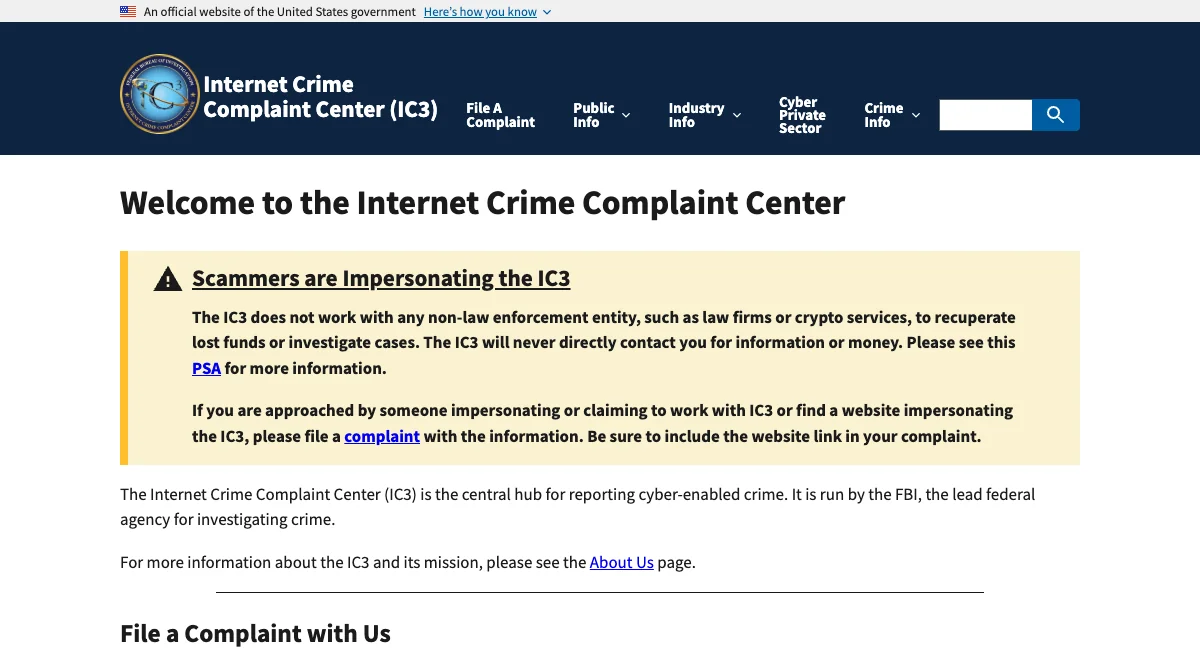
IC3 is the FBI’s place for reporting crime committed online. Its home page says the information you submit lets the FBI investigate, track trends and, in some cases, freeze stolen funds, and it shares reports with FBI field offices and other police. It also says it cannot respond to every complaint. File at ic3.gov, typed in yourself.
The FTC takes fraud reports at ReportFraud.ftc.gov and makes them available to law enforcement. Its page on recovery scams says government agencies and legitimate organisations will never ask for money to help you get a refund.
Outside the US, use your national police or fraud-reporting service. The names change from country to country; the evidence pack does not.
What to send: the one evidence pack they all ask for
All four places above ask for the same facts. Gather them once, in one note, and copy from it each time:
- The transaction ID (TxID) for every transfer, and a link to it on a block explorer, a free website where anyone can look up a transfer on that network. Search the TxID on the explorer and copy the page address.
- Date, time, coin, network, amount and the receiving address, copied, never retyped.
- How it started: the first message, call, advert or website, with names, usernames, phone numbers, email addresses and web addresses.
- Screenshots of the conversation, with the dates visible.
- Anything you paid by card or bank transfer: date, amount, the receiving bank and account.
The FBI’s notice on fake recovery firms asks for exactly this mix: how you were first contacted, the payment details including the receiving crypto addresses, and the institution that received the money.
What none of them will do
This is how to tell a real report from the second scam that tends to follow it:
- None of them charges a fee. The FBI says law enforcement does not charge victims for investigating crimes.
- None of them contacts you first offering recovery. IC3 says it never contacts people directly for information or money, and in July 2026 it warned that scammers are impersonating it to previous victims on Facebook and Telegram.
- None of them works through a private recovery firm. IC3 says it does not work with law firms or crypto services to recover funds, and never refers you to a company that wants payment.
So the message that arrives a few days after you report, offering to trace the funds for a fee, is not a follow-up. The guide to crypto recovery services explains how it is built, and if a company you found yourself looks convincing, the recovery company check shows how old its website is and asks the five questions that settle it.
After you have reported
Keep a single note with every reference number, who you reported to and when. Stop posting the TxID or the amount anywhere public, because that is how recovery scammers find people. And finish securing any account involved, using the first hour after a hack, so there is nothing left to take while the reports do what they can.
Read on 15 November 2026: the IC3 home page; the FBI notices on fictitious law firms targeting crypto scam victims (June 2024) and scammers impersonating the IC3 (July 2026); Binance's How to Report Scams on Binance Support and How to Report Stolen Funds Transferred to Binance. The FTC's refund and recovery scams page was read on 16 October 2026. Outside the US the agency names differ; the order and the evidence do not. Nothing here is legal advice.
Fees, refunds and how fast to file
Do I have to pay anyone to report stolen crypto?
No. The routes that can actually lead somewhere are reports: to the exchanges involved, to the police, and in the US to IC3 and the FTC. They cost nothing and they are the only routes that can lead to a freeze. A company that charges you to make those reports for you is adding nothing, and one that contacted you first is almost certainly a second scam.
Will IC3 or the FTC get my crypto back?
Do not expect it. IC3 says it cannot respond to every complaint, and the FTC collects reports for law enforcement rather than handling individual cases. IC3 also says the information it receives can help the FBI investigate and, in some cases, freeze stolen funds. File with both anyway: the report reference is what an exchange, a bank or a later investigation will ask for.
Someone says they are from IC3 and can speed up my report. Is that real?
No. IC3 says it never contacts people directly for information or money, has no social media presence, and does not work with law firms or crypto services to recover funds. If more information is needed, it comes from an FBI field office or another police officer, not from a message on Telegram or Facebook.
How quickly should I report?
The same day, starting with the exchanges. A freeze can only happen while the funds are still sitting on a platform that can act, and they tend to move on within hours. The police report can follow straight after, because the receiving platform will usually need it before it can do anything.