Binance cannot reverse it. A withdrawal you made yourself is still a withdrawal, and once it is confirmed on the blockchain, the public record every transfer is written to, neither Binance nor anyone else can pull it back. What can sometimes happen is a freeze at the platform the funds landed on, and that depends on two things you control: how fast you report, and whether there is a police report behind it.
So the next hour matters more than the next week. Report the transaction on Binance, write down the evidence once, and file with the police the same day. Ignore anyone who contacts you offering to get it back for a fee, which will start soon.
In the next hour
- Stop sending. If the scammer is still asking for a “fee” or a “tax” to release your funds, that is the scam continuing.
- Open the transaction in your Binance history and press Report Scam.
- Copy the TxID (the transfer’s ID, shown in the withdrawal details), amount, coin, network, receiving address and time into one note.
- Screenshot the conversation that led to it, with dates visible.
- Report to the police today, and keep the reference number.
Why it cannot be reversed, and what can still happen
Binance’s page on sending to a wrong address says its system starts the withdrawal as soon as the request is submitted. Its scam-report page goes further: blockchain transactions are irreversible and anonymous, and despite its efforts it may be unlikely that it, as an exchange, can recover scammed funds.
That leaves one realistic outcome. If the receiving address belongs to an account on a platform that can act, such as another exchange, that platform can freeze the funds while they are still there. For funds that arrive in a Binance account, Binance says it cannot freeze them on its own without an official order from law enforcement or a court. The freeze is a legal process, and the police report is how it starts.
Report it on Binance first
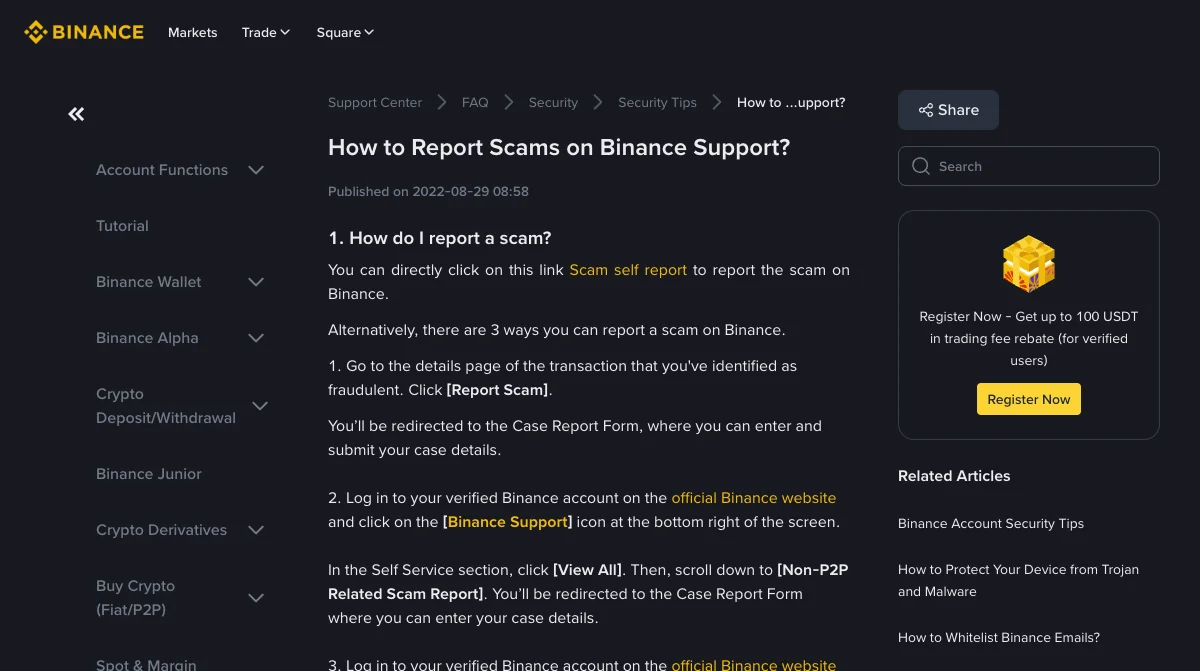
Binance lists three routes to its Case Report Form, all free:
- From the transaction. Open the details page of the withdrawal you made to the scammer and press Report Scam. This is the quickest, because the transaction is already attached.
- From Support. Logged in on the Binance website, click the Binance Support icon, then View All in Self Service, then Non-P2P Related Scam Report.
- From the chat. Tell the support chat “I want to file a scam report” or “I was cheated” and use the form link in its reply.
The form only covers withdrawal and payment scams. You must be logged in to a verified account to use it. Pick the report type that matches what happened; if you cannot find the transaction, widen the date range in your withdrawal history.
Then the police, the same day
Take the same note to your local police or your country’s online fraud-reporting service. In the US that also means the FBI’s IC3 at ic3.gov and the FTC at ReportFraud.ftc.gov. Ask for a reference number.
This step is what makes a freeze possible. Binance says it works with law enforcement, and it may not be able to share investigation details with you, so the police report is the channel through which anything actually moves. The guide to where to report stolen crypto covers each place, what it can do, and the evidence pack they all want.
Check whether they also got into your account
Many of these scams go beyond persuading you to send. If at any point you installed a screen-sharing app, typed a code someone asked for, or logged in through a link they sent, assume the account is exposed:
- Change the Binance password and the email password, from a device the scammer never touched.
- Check the device list, the API keys (access given to outside apps or bots) and the withdrawal whitelist (the addresses saved for sending) for anything you did not add.
- If anything looks wrong, disable the account and follow the first hour after a hack.
If you gave a verification code to the person, the guide to giving a scammer your code explains what that code could unlock.
What not to do next
Do not pay anyone to recover the funds. The messages offering to trace and return them will arrive, especially if you posted about the loss, and the FBI warns that scammers pose as lawyers and even as the FBI to reach previous victims. Law enforcement does not charge victims a fee. The guide to recovery services explains how to recognise the offer, and if a firm you found yourself looks convincing, the recovery company check shows how old its website really is.
Do not send more to “unlock” a withdrawal on the platform that took your money, either. A fake trading site that wants a fee before you can withdraw is still the original scam. The money you already sent is the reason they are still talking to you.
Binance pages read on 15 November 2026: How to Report Scams on Binance Support; and, read on 9 November 2026, What Can I Do If I Withdraw to a Wrong Address? and How to Report Stolen Funds Transferred to Binance. The FBI's notice on fictitious law firms targeting crypto scam victims was read on 15 November 2026. That a confirmed transfer cannot be reversed is how blockchains settle, not a Binance policy. No figure is given for how often funds come back, because we found none we could trace to a source.
Can it be frozen or reversed?
Can Binance reverse a transaction I sent to a scammer?
No. Binance's page on wrong-address withdrawals says the withdrawal starts as soon as the request is submitted, and its scam-report page says blockchain transactions are irreversible. Once a transfer is confirmed on the network, nobody can pull it back. A freeze at the platform that received the funds is the only realistic outcome to aim for.
Can the scammer's account be frozen?
Sometimes. It happens when the funds are still sitting on a platform that can freeze them and the police or a court give that platform the order to do so. That depends on speed and on the funds not having moved on, which is why the report should go in on the same day.
Will Binance tell me what happened with my report?
Probably not in detail. Binance says it may be restricted by law or compliance from sharing details of an ongoing investigation, and it encourages you to report to law enforcement, with whom it works directly.
What report type do I choose on the Binance form?
The one that matches how you were deceived. Binance lists, among others, Fake Investment for high-return platforms and online ‘experts’, Impersonation Scams for anyone posing as Binance staff, a bank, the police or a friend, Remote Access Scams for screen-sharing tools, and Job or Income Scam for deposits demanded before work starts. If nothing fits, choose Others.