Do not decide on the reviews. Every review of a recovery firm describes a result you cannot check, posted on a page the firm can fill, and fake reviews are the cheapest part of a recovery scam to produce. Run three checks that do not depend on anything the firm wrote: how old its website is, whether it wants money before anything comes back, and whether the people it names exist outside its own pages.
The FBI’s advice on recovery adverts says to research the company and to be wary of vague language, a minimal online presence, and promises that it can recover funds. Hundreds of glowing reviews are not a presence. They are content.
Three checks, ten minutes, no help from the firm
- Website age. Paste its address into the recovery company check. A firm claiming years of experience on a site registered months ago has told you something.
- Money direction. Any fee, deposit, tax or percentage before funds come back is the scam, whatever the reviews say.
- The named people. Look up the lawyer or investigator yourself, in the official register where they claim to work. No entry, no deal.
Why five-star reviews cannot prove a recovery firm is real
Think about what a genuine five-star review of a recovery firm would have to say: that money confirmed on a blockchain came back. That does not happen through a private firm. What does sometimes happen is a freeze by a platform after a police report, which is free and would have happened anyway.
So a review full of gratitude is either describing that free route and giving the firm credit, or describing something that did not happen. Either way it tells you nothing about what the firm will do with your fee.
What fake reviews tend to look like
No single sign proves a review is fake, but several together are hard to explain any other way:
- Reviewers with one review. A profile that has only ever reviewed this firm, created recently.
- Bursts. Many reviews in a few days, then silence, then another burst.
- The same story told twice. Similar amounts, similar timelines, the same phrases, the same name of the “agent who helped me”.
- A contact handle or email in the text. A real review rarely tells you to message a particular person on Telegram.
- No complaint goes unanswered, and every answer pushes you to email them.
- On Reddit: accounts with little history, comments that mention the firm under posts about losses, and other accounts arriving to agree.
The last pattern overlaps with the replies people get after posting about a loss, which the guide to recovery agents on social media covers in detail.
Check the website’s age, not its reviews
The date a website’s address (its domain) was first registered is a public fact, kept by the registry, the body that runs names ending in .com, .io and the like, and outside the firm’s control. Paste the firm’s address into the recovery company check and it asks the registry directly, shows when the domain was first registered, and tells you if the domain is on California DFPI’s crypto scam complaint list.
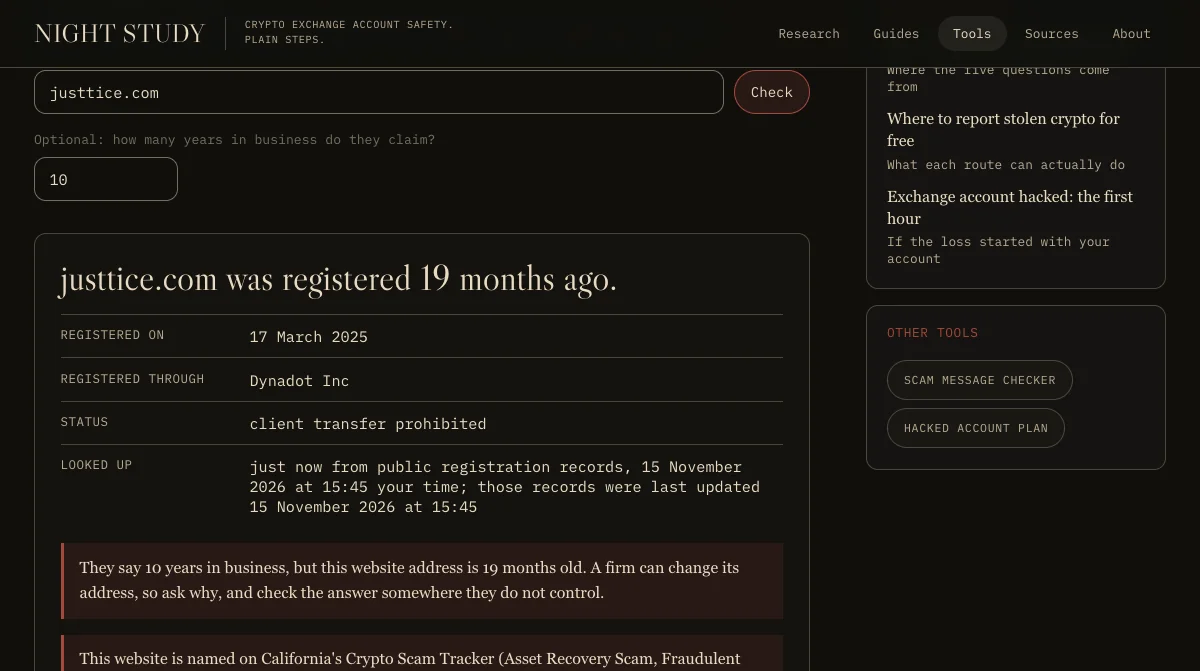
A young domain is not proof of fraud on its own; honest businesses start somewhere. But a firm that says it has recovered funds for clients for a decade, on a site registered this year, is contradicting itself, and the check will point that out if you enter the years it claims.
Check the payment terms
This check outranks every review. If the firm asks for any money before funds actually come back to you, stop, regardless of what the money is called. The FBI describes fake law firms asking victims to pay part of the fee up front, and to pay back taxes and other fees to recover their funds. The FTC says government agencies and legitimate organisations will never ask for money to help you get a refund.
Ask them in writing: “Is there any payment from me before money is back in my own account?” A yes ends it.
Check the people
Recovery sites name people: a lawyer, a former investigator, a “case manager”. If a lawyer is named, find them in the official register of lawyers where the firm says they practise, and contact them through the details on that register. If they claim to work with the FBI, IC3 or a regulator, the FBI’s own notices answer it: IC3 does not work with law firms or crypto services to recover funds, and law enforcement does not charge victims for investigating.
If the people cannot be found anywhere except the firm’s site and its reviews, you have your answer. The full guide to recovery services lists the five questions in order, and if you have already paid, what to do next starts with your bank.
Sources, read on 15 November 2026: the FBI's notice on fictitious law firms targeting crypto scam victims, the FBI's July 2026 notice on scammers impersonating the IC3, and California DFPI's Crypto Scam Tracker, whose entries are complaints submitted by the public and not verified by the DFPI. The FTC's refund and recovery scams page was read on 16 October 2026. We do not name or rate any recovery company.
Legit firms, Trustpilot and a friend's tip
Are there any legit crypto recovery services?
Blockchain tracing is a real industry, but it sells to exchanges, insurers, law enforcement and law firms, not to individuals through adverts and five-star reviews. Nobody can reverse a confirmed transfer. If you want professional help with a large loss, the route is a regulated lawyer you found through an official register, who decides whether any tracing is worth paying for.
The firm has a Trustpilot page with hundreds of reviews. Does that mean anything?
Not on its own. A review page shows what people chose to post about the firm, and a recovery scam has every reason to fill it. Look at the reviewers rather than the score: how many reviews each has written, when they were posted, and whether they repeat the same phrases or the same contact name.
What if a friend recommends a recovery company?
Ask how they found it and what they paid before anything came back. If the money came back because an exchange froze funds after a police report, that was the free route, not the company. If they are still waiting for the final release, they may be in the middle of the scam themselves.